Looking Beyond the Longer LK5 Pro Large Open-Source 3D Printer? 6 Alternatives Worth a Look
As Amazon Associates, we earn from qualifying purchases. This means we may receive a small commission at no extra cost to you if you click through and make a purchase.
As an Amazon Associate we earn from qualifying purchases. Links on this page are affiliate links.
The Longer LK5 Pro offers a 300 x 300 x 400 mm build volume and open-source firmware for large projects. If you are looking for longer lk5 pro large open source 3d printer alternatives, you might want different specs or a smaller footprint. This printer targets beginners with its 180 mm/s speed and stable triangular structure. It includes resume printing and filament detection to save material.
The 6 alternatives on this list overlap with the LK5 Pro in key areas like FDM technology and beginner-friendly features. You may prefer a fully enclosed chamber for ABS printing or a faster CoreXY system. Some options focus on multi-color output or compact designs. Each product here shares the open-source or accessible nature of the original while offering distinct advantages. You can choose based on your specific needs for speed, size, or material compatibility without sacrificing reliability.
How alternatives differ from the LK5 Pro
Longer LK5 Pro Large-Format 3D Printer
This model shares the same 300 x 300 x 400 mm build volume and open-source FDM architecture as the LK5 Pro. It targets beginners who need large-format printing without multi-color capabilities. You get the same stability and resume printing features found in the original. The main difference lies in the specific model designation and slight dimensional variations in the frame. If you want the largest possible print area from the Longer brand, this variant offers the same core utility. It is a practical choice for large single-material projects where open-source flexibility is your priority.
Bambu Lab P1S Enclosed 3D Printer
The Bambu Lab P1S trades the LK5 Pro’s massive 400 mm height for a fully enclosed chamber. Its build volume is smaller at 256 x 256 x 256 mm, but the enclosure allows for advanced materials like ABS and PC. You gain a CoreXY structure for better stability at higher speeds. This printer suits users who prioritize print quality and material versatility over sheer size. If you work with engineering filaments that require temperature control, the P1S is the safer option. It sacrifices build volume for a controlled environment that reduces warping and improves consistency.
Bambu Lab P2S High-Speed FDM Printer
The Bambu Lab P2S offers significantly higher speeds up to 600 mm/s compared to the LK5 Pro’s 180 mm/s. It uses a CoreXY structure for faster acceleration and precise movements. The build volume is smaller, focusing on speed and automation rather than large formats. You get automated calibration and high-speed performance for detailed parts. This printer is ideal for beginners who want quick results without manual tuning. It gives up the open-source firmware and large build area for superior speed and ease of use. Choose this if speed and automation matter more than print size.
Bambu Lab A1 FDM 3D Printer
The Bambu Lab A1 is a compact option with a much smaller build volume than the LK5 Pro. It focuses on automated setup and high-speed precision for small projects. You get quiet operation and reliable performance without manual adjustments. This printer suits beginners and kids who want hassle-free printing. It sacrifices the large open-source platform for a plug-and-play experience. If you primarily print small figures or prototypes, the A1 offers better convenience. It gives up the ability to make large objects for superior ease of use and consistent quality.
Anycubic Kobra X Multicolor 3D Printer
The Anycubic Kobra X introduces multi-color printing with AI monitoring, which the LK5 Pro lacks. It features a 260 mm build volume, slightly smaller than the LK5 Pro’s width but taller. You get high-speed printing up to 600 mm/s and automated color switching. This printer is best for makers who want vibrant, multi-material projects. It trades the open-source flexibility for advanced automation and camera monitoring. If you value speed and color variety over large single-color prints, the Kobra X is a strong alternative. It offers a modern, automated workflow for complex designs.
Creality K2 SE 4-Color Printer
The Creality K2 SE provides 4-color printing with a 500 mm/s speed, outpacing the LK5 Pro. Its build volume is compact, prioritizing speed and multi-color output over size. You get auto-leveling and CoreXY structure for reliable performance. This printer suits hobbyists who want fast, colorful prints without manual calibration. It gives up the large open-source platform for a streamlined, automated experience. If you need vibrant, multi-material projects quickly, the K2 SE is ideal. It offers a balance of speed and color capabilities for users who do not require large-format printing.
| # | Product | Best for | Price |
|---|---|---|---|
| 1 | Longer LK5 Pro Large Open-Source 3D Printer Best overall | large open-source printing projects | |
| 2 | Longer LK5 Pro Large-Format 3D Printer Best budget | large open-source printing projects | |
| 3 | Bambu Lab P1S Enclosed 3D Printer Best enclosure | Advanced filament printing in an enclosed chamber | |
| 4 | Bambu Lab P2S High-Speed FDM Printer Best premium | Beginners needing high-speed CoreXY performance | |
| 5 | Bambu Lab A1 FDM 3D Printer Also great | Beginners seeking automated, high-speed small prints | |
| 6 | Anycubic Kobra X Multicolor 3D Printer Best camera | fast multicolor printing with AI monitoring | |
| 7 | Creality K2 SE 4-Color Printer Best 500 mm/s | fast multicolor printing with a compact footprint |

Longer LK5 Pro Large Open-Source 3D Printer
Best for: large open-source printing projects
- Build Volume
- 300 x 300 x 400 mm
- Max Print Speed
- 180mm/s
- Printing Technology
- FDM
- Features
- Resume Printing
- Target Audience
- Beginners
- Dimensions
- 20 × 20 × 15 inches
The Longer LK5 Pro 3 is an open-source FDM 3D printer with a 300 x 300 x 400 mm build volume. It prints at 180 mm/s with 0.1 mm precision. The triangular frame and auto-calibration reduce vibration. You get filament detection and auto-resume features. It is 90% pre-assembled for easier setup. This model suits users who need a large canvas and customizable firmware for home or school projects.
- 300 x 300 x 400 mm build volume
- 180 mm/s maximum print speed
- 0.1 mm precision with axis calibration
- Open-source firmware for customization
- Filament depletion and power outage detection
- 180 mm/s speed is slower than competitors reaching 500 mm/s
- 20 x 20 x 15 inch footprint is bulkier than compact models
- FDM technology lacks native multi-color capability
- You need a large build volume for big projects
- You want open-source firmware for advanced customization
- You prefer a stable triangular frame structure
- You require native multi-color printing
- You need ultra-fast speeds over 300 mm/s
- You have very limited desk space
Verdict: The Longer LK5 Pro 3 300mm Large Printer fits users who prioritize a large build area and open-source flexibility. It is a practical choice for those who need stability and do not require multi-color output.
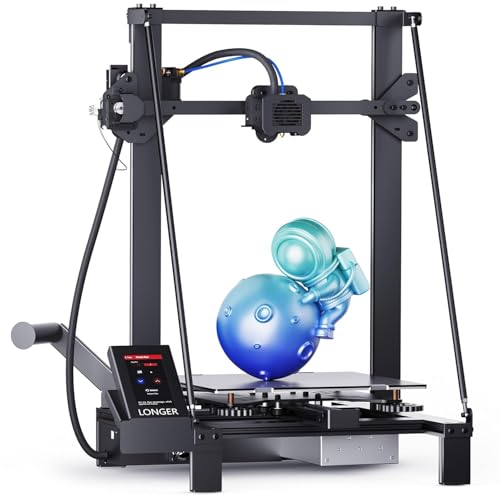
Longer LK5 Pro Large-Format 3D Printer
Best for: large open-source printing projects
- Build Volume
- 300*300*400mm
- Max Print Speed
- 180mm/s
- Printing Technology
- FDM
- Features
- Resume Printing
- Target Audience
- Beginners
- Dimensions
- 11.8 × 15.7 × 11.8 inches
The Longer LK5 Pro 3 offers a 300x300x400mm build volume for large projects. It prints at 180mm/s using FDM technology. The machine features a stable triangular structure and open-source firmware. You get 90% pre-assembly for easy setup. It includes filament and power outage detection for reliability. This printer suits beginners who need a spacious canvas.
- 300x300x400mm large build volume
- 180mm/s high-speed printing
- Open-source firmware for customization
- Filament and power outage detection
- 180mm/s max speed is slower than competitors reaching 500mm/s
- Single-color printing limits multi-material projects
- You need a large build volume for bigger models
- You want open-source firmware for customization
- You are a beginner looking for pre-assembled ease
- You require multi-color printing capabilities
- You need print speeds exceeding 180mm/s
- You prefer a closed ecosystem for simplicity
Verdict: The Longer LK5 Pro 3 Large 3D Printer fits users who prioritize a large 300x300x400mm build area and open-source flexibility over high-speed or multi-color performance.

Bambu Lab P1S Enclosed 3D Printer
Best for: Advanced filament printing in an enclosed chamber
- Max Print Speed
- 500mm/s
- Printing Technology
- FDM, CoreXY
- Multicolor Capacity
- Up to 16 colors
- Enclosure Type
- Fully enclosed
- Bed Leveling
- Automatic
- Features
- Enclosure, CoreXY Structure
The Bambu Lab P1S is a ready-to-use FDM printer with a fully enclosed design. It features CoreXY kinematics and automatic bed leveling. The unit supports speeds up to 500mm/s. It is ideal for beginners who need a stable print environment for advanced materials like ABS or PC. The build volume is 18×15.3×15.3 inches.
- Fully enclosed body for advanced filament stability
- CoreXY structure with 500mm/s max speed
- Automatic bed leveling for consistent first layers
- Supports ABS, ASA, PC, and PETG filaments
- Heavier 39-pound build compared to open-frame competitors
- Smaller 18-inch width limits large single-part prints
- Multi-color printing requires separate AMS accessory
- You need an enclosed chamber for engineering plastics
- You want automatic bed leveling to reduce setup time
- You prefer a stable CoreXY kinematic system
- You require native multi-color printing without extra hardware
- You need a larger build volume than 18 inches
- You prefer a lightweight portable machine under 30 pounds
Verdict: Bambu Lab P1S Enclosed FDM Printer suits users who prioritize print stability and advanced material support over maximum build size. It is a solid choice for beginners working with ABS or PC who value a fully enclosed environment.

Bambu Lab P2S High-Speed FDM Printer
Best for: Beginners needing high-speed CoreXY performance
- Max Print Speed
- 600 mm/s
- Printing Technology
- FDM, CoreXY
- Bed Leveling
- Automatic calibration
- Features
- CoreXY Structure
- Target Audience
- Beginners
- Dimensions
- 18 × 21 × 18 inches
The Bambu Lab P2S is a CoreXY FDM printer built for beginners who need speed and precision. It reaches 600 mm/s print speeds while maintaining sharp corners through active flowrate compensation. The machine includes automatic calibration and AI failure detection to simplify the workflow. It features an adaptive airflow system for various materials. This ready-to-use unit fits users who want high-quality results without complex setup.
- 600 mm/s maximum print speed
- CoreXY structure for stability
- Automatic bed leveling and calibration
- Adaptive airflow system
- Print volume is 11.8 x 11.8 x 15.7 inches, matching the LK5 Pro but smaller than the K2 SE 4C
- Standard P2S model does not include multi-color printing capability
- You want a ready-to-use FDM printer with high speed
- You need automatic calibration to simplify setup
- You print with engineering-grade materials requiring chamber heat
- You need native multi-color printing without buying a combo
- You require a larger build volume than 11.8 x 11.8 x 15.7 inches
- You prefer a manual leveling process
Verdict: Bambu Lab P2S 3D Printer delivers high-speed CoreXY performance for beginners. It suits users who prioritize speed and automated calibration over built-in multi-color printing.

Bambu Lab A1 FDM 3D Printer
Best for: Beginners seeking automated, high-speed small prints
- Printing Technology
- FDM
- Bed Leveling
- Automatic
- Target Audience
- Beginners, Kids
- Dimensions
- 21.8 × 20.8 × 12.9 inches
- Weight
- 22 pounds
The Bambu Lab A1 is a ready-to-use FDM printer designed for beginners and kids. It features an acceleration of 10,000 mm/s² for fast, precise prints. Full-auto calibration handles bed-leveling and Z-offset automatically. Active flow rate compensation ensures smooth extrusion. The unit measures 20.8 x 21.8 x 12.9 inches and weighs 22 pounds. It supports multi-color printing with the optional AMS lite accessory.
- 10,000 mm/s² acceleration for high-speed precision
- Full-auto calibration for bed-leveling and Z-offset
- Active flow rate compensation for consistent prints
- 1-Clip quick swap nozzle for easy maintenance
- Active motor noise canceling for quiet operation
- Smaller build volume than the 11.8×11.8×15.7in options on this list
- 22-pound weight adds bulk compared to lighter entry models
- Multi-color capability requires purchasing the separate AMS lite accessory
- You want a fully automated setup with no manual calibration
- You are a beginner or printing for kids
- You prioritize speed and precision for small to medium parts
- You need large format printing exceeding 11.8 inches
- You want multi-color printing included in the base price
- You prefer a significantly lighter or more compact footprint
Verdict: Bambu Lab A1 FDM 3D Printer is a solid choice for beginners who value automated setup and high-speed precision for smaller projects. It fits users who want reliable, quiet operation without the hassle of manual adjustments.

Anycubic Kobra X Multicolor 3D Printer
Best for: fast multicolor printing with AI monitoring
- Build Volume
- 260 x 260 x 260 mm
- Max Print Speed
- 600 mm/s
- Printing Technology
- FDM
- Multicolor Capacity
- 4-color (expandable to 19 colors)
- Bed Leveling
- LeviQ 3.0 (Automatic)
- Connectivity
- Dual-band Wi-Fi (2.4G/5G), LAN
The Anycubic Kobra X is an FDM printer with a 260 x 260 x 260 mm build volume. It supports native 4-color printing, expandable to 19 colors. Max print speed reaches 600 mm/s. It includes AI monitoring and dual-band Wi-Fi. This unit suits users wanting fast, multi-color output without complex setup.
- Native 4-color printing with expansion to 19 colors
- 600 mm/s maximum print speed
- 260 x 260 x 260 mm build volume
- AI camera for spaghetti detection
- 260 mm build volume is smaller than the 300 mm+ options on this list
- 20.9 pound weight adds bulk compared to lighter entry-level models
- Requires separate filament purchase for the 4 ACE 2 Pro system
- You need native multicolor capability for detailed prints
- You want fast printing speeds up to 600 mm/s
- You prefer AI monitoring for remote oversight
- You require a build volume larger than 260 mm
- You want filament included in the box
- You need a printer under 20 pounds
Verdict: Anycubic Kobra X 260mm Multicolor FDM delivers high-speed multicolor printing for makers who value AI monitoring and fast output over large build volumes.

Creality K2 SE 4-Color Printer
Best for: fast multicolor printing with a compact footprint
- Build Volume
- 220×215×245mm
- Max Print Speed
- 500mm/s
- Printing Technology
- CoreXY, FDM
- Multicolor Capacity
- 4-color
- Bed Leveling
- Auto Leveling
- Connectivity
- USB
The Creality K2 SE 4C is a CoreXY FDM printer built for speed and color. It reaches 500mm/s with 20,000mm/s² acceleration, making it one of the fastest options here. It supports native 4-color printing and includes auto bed leveling. The build volume is 220×215×245mm. This machine suits beginners who want multicolor results without complex setup.
- 500mm/s max print speed with high acceleration
- Native 4-color multicolor printing capability
- Auto bed leveling for consistent first layers
- CoreXY motion system for smooth movement
- 220×215×245mm build volume is smaller than the 300mm+ volumes of the Longer LK5 Pro and Bambulab P1S
- USB-only connectivity lacks the wireless options found on other models
- You want fast, high-quality prints with multiple colors
- You prefer a CoreXY system for better speed and accuracy
- You need auto bed leveling to simplify your workflow
- You require a build volume larger than 220mm in any dimension
- You need wireless connectivity for remote monitoring
- You are looking for the largest possible print area in this list
Verdict: The Creality K2 SE 4C 500mm/s CoreXY fits users who prioritize speed and multicolor output over maximum build size. It is ideal for hobbyists who want reliable, fast prints with less manual calibration.
Specifications side by side
| Spec | Longer LK5 Pro Large Open-Source 3D Printer | Longer LK5 Pro Large-Format 3D Printer | Bambu Lab P1S Enclosed 3D Printer | Bambu Lab P2S High-Speed FDM Printer | Bambu Lab A1 FDM 3D Printer | Anycubic Kobra X Multicolor 3D Printer | Creality K2 SE 4-Color Printer |
|---|---|---|---|---|---|---|---|
| Build Volume | 300 x 300 x 400 mm | 300*300*400mm | – | – | – | 260 x 260 x 260 mm | 220×215×245mm |
| Max Print Speed | 180mm/s | 180mm/s | 500mm/s | 600 mm/s | – | 600 mm/s | 500mm/s |
| Printing Technology | FDM | FDM | FDM, CoreXY | FDM, CoreXY | FDM | FDM | CoreXY, FDM |
| Multicolor Capacity | – | – | Up to 16 colors | – | – | 4-color (expandable to 19 colors) | 4-color |
| Enclosure Type | – | – | Fully enclosed | – | – | – | – |
| Bed Leveling | – | – | Automatic | Automatic calibration | Automatic | LeviQ 3.0 (Automatic) | Auto Leveling |
| Connectivity | – | – | – | – | – | Dual-band Wi-Fi (2.4G/5G), LAN | USB |
| Printing Speed | – | – | – | 600 mm/s | – | 600 mm/s | 500 mm/s |
| Features | Resume Printing | Resume Printing | Enclosure, CoreXY Structure | CoreXY Structure | – | Camera, Multi-Color Printing, AI Camera | Auto Leveling, Multi-Color Printing |
| Target Audience | Beginners | Beginners | Beginners | Beginners | Beginners, Kids | Beginners | Beginners, Kids |
| Structure | – | – | Enclosed | – | – | – | – |
| Dimensions | 20 × 20 × 15 inches | 11.8 × 15.7 × 11.8 inches | 15.3 × 18 × 15.3 inches | 18 × 21 × 18 inches | 21.8 × 20.8 × 12.9 inches | 23 × 13 × 22 inches | 14.5 × 14.5 × 19 inches |
| Weight | – | – | 39 pounds | – | 22 pounds | 20.9 pounds | – |
| Size | Longer-LK5 Pro | – | P1S (Without AMS) | P2S | A1 | – | – |
| Color | Black | Black | Black | Grey | Grey | Grey | Black |
| Model | LK5 Pro | LK5 Pro-B1 | P1S | PF004-U-AU | PF002-A | – | – |
Frequently asked questions
Does the Bambu Lab P1S offer a larger build volume than the Longer LK5 Pro?
No. The Bambu Lab P1S has a smaller footprint than the Longer LK5 Pro. Its dimensions are 18 x 15.3 x 15.3 inches. The LK5 Pro provides a 300 x 300 x 400 mm build area. You should choose the P1S if you prioritize an enclosed chamber for stable printing over maximum size.
Which alternative supports multi-color printing better than the single-color LK5 Pro?
The Anycubic Kobra X and Creality K2 SE support multi-color output. The Kobra X features AI monitoring and a 600 mm/s speed. The K2 SE offers 4-color printing at 500 mm/s. The LK5 Pro lacks multi-color capabilities. These models suit you if color variety matters more than open-source flexibility.
Is the Bambu Lab P2S faster than the Longer LK5 Pro?
Yes. The Bambu Lab P2S delivers high-speed CoreXY performance. It is designed for beginners needing speed and automated calibration. The LK5 Pro focuses on stability and large format printing. If you prioritize rapid output over open-source firmware, the P2S is a strong alternative for your workflow.
Can I use the Bambu Lab A1 for large open-source projects?
No. The Bambu Lab A1 is designed for smaller projects. It weighs 22 pounds and offers automated setup. The LK5 Pro provides a much larger build volume. The A1 suits beginners seeking quiet, precise operation for small items. It does not match the large format capability of the LK5 Pro.
Does the Anycubic Kobra X include a camera for monitoring?
Yes. The Anycubic Kobra X includes an AI camera feature. It supports fast multicolor printing at 600 mm/s. The LK5 Pro does not list camera integration. If you want AI monitoring and high-speed output, the Kobra X is a practical choice. It fits users who value automation over large build areas.
Is the Creality K2 SE suitable for beginners who want speed?
Yes. The Creality K2 SE features 500 mm/s printing and auto leveling. It supports 4-color output with a compact footprint. The LK5 Pro lacks these speed and color features. This model is ideal for hobbyists who want reliable, fast prints with less manual calibration compared to the open-source LK5 Pro.
Which printer is best for printing with ABS or PC materials?
The Bambu Lab P1S is best for these materials. It features a fully enclosed chamber for print stability. The LK5 Pro is an open-source model without an enclosure. If you need to print advanced filaments like ABS or PC, the P1S provides the controlled environment required. It suits beginners valuing material support over size.