Creality 3D Scanner Sermoon S1 or Creality 3D Scanner Sermoon P1? Which Creality Model to Buy
As Amazon Associates, we earn from qualifying purchases. This means we may receive a small commission at no extra cost to you if you click through and make a purchase.
As an Amazon Associate we earn from qualifying purchases. Links on this page are affiliate links.
When you compare the creality 3d scanner sermoon s1 vs 3d scanner sermoon p1, you find two high-precision wireless tools. Both offer 0.02mm accuracy and blue laser scanning. The main difference lies in their processing power. The Sermoon S1 relies on a scan bridge for wireless operation. The Sermoon P1 is a standalone device with a built-in touchscreen and powerful internal hardware. This distinction changes how you handle data and scan objects.
Processing & Operation
Requires scan bridge for wireless scanning
Standalone with 6" touchscreen and 8-core CPU
Laser Line Count
34+7+1 lines
22+7+1 lines
Max Scan Speed
90fps
100fps
Target Object Size
5mm³ to 1245mm x 754mm
5x5x5 mm³ to 4000x4000x4000 mm³
Choose the first if
- You need to scan larger flat surfaces up to 1245mm x 754mm
- You prefer a higher density of laser lines for detailed capture
- You already have a compatible computer and scan bridge setup
Choose the second if
- You want to scan very large objects up to 4000mm cubed
- You need a fully wireless, standalone device without a computer
- You require the fastest scan speed of 100fps for efficiency
Verdict
Choose the Sermoon S1 if you prioritize higher laser line density and have a stable scanning station. Pick the Sermoon P1 if you need to scan massive objects or require a completely portable, all-in-one solution. Both models deliver the same metrology-grade accuracy for your projects.
Sermoon S1 vs P1 Specs
Processing Power
Edge: Creality Sermoon P1 Wireless 3D Scanner
The Sermoon P1 operates as a standalone device, powered by a Qualcomm 8-core 3.36 GHz CPU and an Adreno 740 GPU. It includes 24GB of LPDDR5X RAM and 256GB of ROM, allowing you to scan without a computer. The Sermoon S1 requires a scan bridge for wireless scanning, meaning it depends on external hardware to process data. This makes the P1 more portable for field work, while the S1 is designed for desktop integration with a bridge unit.
Scanning Speed
Edge: Creality Sermoon P1 Wireless 3D Scanner
When comparing data collection rates, the Sermoon P1 offers a scan speed of 100 FPS. The Sermoon S1 provides a slightly lower speed at 90 FPS. Both models support high point collection rates, with the S1 reaching up to 4,600,000 points per second. The P1’s higher frame rate may benefit users who need to capture dynamic surfaces or large objects more quickly. For most static industrial design tasks, both speeds are sufficient, but the P1 holds a technical advantage in raw throughput.
Laser Configuration
Edge: Creality Sermoon S1 Wireless 3D Scanner
The Sermoon S1 features a versatile laser system with 34, 7, and 1-line blue laser modes, plus short and long-range scattered beam structured light. The Sermoon P1 uses 22, 7, and 1-line blue lasers along with NIR structured light. The S1’s 34-line mode allows for broader coverage in a single pass, which can reduce scanning time for large items. The P1’s single-line laser is optimized for deep holes and narrow gaps. Both achieve 0.02mm accuracy, but the S1 offers more line options for varied surface geometries.
Target Object Size
Edge: Creality Sermoon P1 Wireless 3D Scanner
The maximum scanning volume differs significantly between the two models. The Sermoon S1 supports objects up to 1245mm x 754mm. The Sermoon P1 can handle much larger scenes, up to 4000mm x 4000mm x 4000mm. If you need to scan large car bodies, architectural elements, or industrial machinery, the P1 is the better choice. For smaller parts like jewelry or mechanical components, both models cover the minimum size of 5mm³ effectively. The P1’s range is superior for large-scale applications.
Display and Interface
Edge: Creality Sermoon P1 Wireless 3D Scanner
The Sermoon P1 includes a 6-inch touchscreen, enabling you to operate the scanner independently without connecting to a computer or bridge. This feature supports its all-in-one design and standalone workflow. The Sermoon S1 does not list an integrated display, relying instead on the scan bridge and software interface for operation. For users who prefer a mobile, cable-free experience, the P1’s built-in screen is a practical advantage. The S1 is better suited for stationary setups where a bridge is already present.
Which Creality 3D Scanner suits you
Users needing standalone scanning
Our pick: Creality Sermoon P1 Wireless 3D Scanner
The Sermoon P1 operates independently with a 6-inch touchscreen and powerful internal hardware. You do not need a computer or external bridge to capture data. This all-in-one design allows you to scan complex objects directly on the device. It is ideal for field work where carrying a laptop is impractical.
Professionals scanning large environments
Our pick: Creality Sermoon P1 Wireless 3D Scanner
The Sermoon P1 supports a massive scanning range up to 4000x4000x4000 mm³. You can capture expansive scenes like car bodies or large architectural features without stitching multiple small scans. The wide coverage reduces setup time and allows you to handle diverse object sizes with a single device configuration.
Scanners prioritizing high speed
Our pick: Creality Sermoon S1 Wireless 3D Scanner
The Sermoon S1 achieves a scan speed of 90fps with a rate of 4.6 million points per second. You benefit from rapid data collection when capturing dynamic surfaces or complex geometries. This speed helps you improve workflow efficiency and complete detailed industrial design or reverse engineering tasks in less time.
Users needing flexible lighting modes
Our pick: Creality Sermoon S1 Wireless 3D Scanner
The Sermoon S1 offers five working modes, including single, seven, and thirty-four line lasers. You can switch between short and long-range structured light to adapt to different textures. This flexibility helps you handle everything from small 5mm³ parts to larger objects while maintaining high precision in varied lighting conditions.
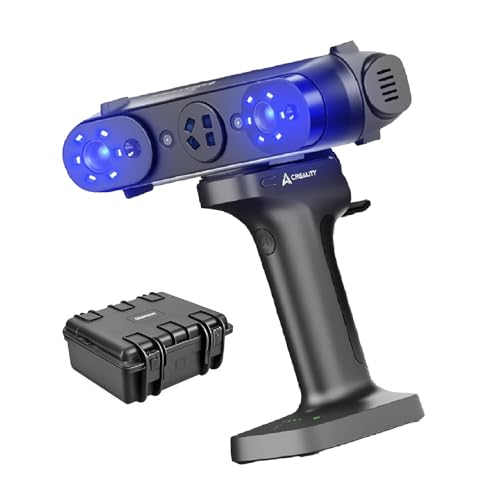
Creality Sermoon S1 Wireless 3D Scanner
Best for: Industrial design and large object scanning
- Accuracy
- 0.02mm
- Light Source
- Blue Laser & Structured Light
- Scan Speed
- 90fps
- Laser Line Count
- 34+7+1 lines
- Target Object Size
- 5mm³ to 1245mm x 754mm
- Connectivity
- Wireless
The Creality Sermoon S1 is a high-precision 3D scanner designed for industrial and artistic use. It features a blue laser and structured light system with 34+7+1 lines, achieving 0.02mm accuracy. You can scan objects ranging from 5mm³ to large scenes up to 1245mm x 754mm. It captures color textures and supports wireless scanning with a scan bridge. This model suits users needing detailed reverse engineering or outdoor scanning capabilities.
- 0.02mm high precision for detailed parts
- Scans up to 4,600,000 points per second
- Captures realistic color textures with RGB lights
- Works in strong light up to 100,000 lux
- Flexible modes for small to large objects
- Requires a scan bridge for wireless operation
- Physical dimensions of 2x2x5 inches may limit portability
- Scanning speed capped at 90fps
- You need high-precision reverse engineering
- You scan large objects or scenes
- You work in bright outdoor environments
- You want a fully wireless unit without accessories
- You only scan tiny parts under 5mm
- You need a smaller portable device
Verdict: Creality Sermoon S1 3D Scanner offers industrial-grade precision and large-scale scanning for professionals. It fits users who need detailed color capture and robust performance in varied lighting conditions.

Creality Sermoon P1 Wireless 3D Scanner
Best for: high-precision standalone scanning of large objects
- Accuracy
- 0.02mm
- Light Source
- Blue laser, NIR structured light
- Scan Speed
- 100FPS
- Laser Line Count
- 22+7+1 lines
- Target Object Size
- 5x5x5 mm³ to 4000x4000x4000 mm³
- Operation Mode
- Standalone with 6" touchscreen
The Creality Sermoon P1 is a standalone 3D scanner with a 6-inch touchscreen and wireless operation. It uses 22+7+1 blue laser lines and infrared structured light to achieve 0.02mm accuracy. The device processes data on its own Qualcomm 8-core CPU with 24GB RAM, requiring no computer during capture. It scans objects from 5mm to 4000mm. This unit suits users who need metrology-grade precision for complex parts or large items without tethering to a PC.
- 0.02mm accuracy with single-line blue laser
- Standalone operation with 6-inch touchscreen
- 22+7+1 laser line configuration
- Scans from 5mm³ to 4000mm³
- 24GB LPDDR5X RAM for fast processing
- Heavier build at 1.72 pounds
- Requires high-end PC for post-processing
- Limited to 100FPS scan speed
- You need to scan intricate engine parts or car bodies
- You want to scan outdoors without cables
- You require metrology-grade accuracy for quality control
- You only scan small figurines under 5mm
- You prefer a lighter handheld device
- You have a low-end PC with 8GB RAM
Verdict: Creality Sermoon P1 Wireless Scanner is best for professionals needing high-precision scans of large or complex objects without a computer tether. It fits users who value standalone wireless operation and detailed laser coverage.
Specifications side by side
| Spec | Creality Sermoon S1 Wireless 3D Scanner | Creality Sermoon P1 Wireless 3D Scanner |
|---|---|---|
| Accuracy | 0.02mm | 0.02mm |
| Light Source | Blue Laser & Structured Light | Blue laser, NIR structured light |
| Scan Speed | 90fps | 100FPS |
| Laser Line Count | 34+7+1 lines | 22+7+1 lines |
| Target Object Size | 5mm³ to 1245mm x 754mm | 5x5x5 mm³ to 4000x4000x4000 mm³ |
| Operation Mode | – | Standalone with 6" touchscreen |
| Connectivity | Wireless | – |
| Color Capture | Color Texture Mapping | – |
| Features | – | Touchscreen |
| Laser Type | – | Infrared Laser |
| Application | Outdoor Scanning | – |
| Dimensions | 5 × 2 × 2 inches | – |
| Weight | – | 1.72 pounds |
| Model | Sermoon S1 | Sermoon P1 |
| Size | – | Sermoon P1 |
| Color | – | Black |
Frequently asked questions
Can the Creality Sermoon S1 scan outdoors?
Yes, the Sermoon S1 is designed for outdoor scanning. It uses blue laser and structured light to maintain accuracy in varied lighting conditions. This makes it suitable for industrial design tasks that require large object capture outside a controlled studio environment.
Does the Sermoon P1 have a built-in screen?
Yes, the Sermoon P1 features a touchscreen. This allows you to operate the device as a standalone unit without needing an external monitor. You can control settings and view scans directly on the hardware, which supports its wireless, untethered workflow.
Is the Creality Sermoon S1 wireless?
Yes, the Sermoon S1 offers wireless connectivity. It is designed for industrial-grade precision and robust performance. While it connects wirelessly, it typically works with a scan bridge to process data, ensuring detailed color capture and high accuracy for professional users.
What laser type does the Sermoon P1 use?
The Sermoon P1 uses infrared laser technology. It also incorporates blue laser scanning for high-precision results. This combination allows you to capture detailed scans of large or complex objects. The device operates independently, making it ideal for professionals who need standalone capability.
How accurate are both Creality scanners?
Both the Sermoon S1 and Sermoon P1 offer 0.02mm accuracy. This high precision ensures detailed and reliable scans for professional applications. Whether you choose the S1 for outdoor use or the P1 for standalone operation, you get consistent measurement quality in your data.
Which model is best for large objects?
The Sermoon S1 is best for large object scanning. It is optimized for industrial design and outdoor environments. The Sermoon P1 also handles large objects well due to its standalone power. However, the S1 is specifically noted for its large-scale scanning capabilities.
Can I use the Sermoon P1 without a computer?
Yes, you can use the Sermoon P1 without a computer. It includes powerful internal hardware, such as a Qualcomm 8-core CPU and 24GB of RAM. This allows you to scan complex objects independently. The wireless design and touchscreen interface support this fully standalone workflow.