3 Best Fiber Laser 3d Printers, Compared
As Amazon Associates, we earn from qualifying purchases. This means we may receive a small commission at no extra cost to you if you click through and make a purchase.
As an Amazon Associate we earn from qualifying purchases. Links on this page are affiliate links.
We compared 3 best fiber laser 3d printers to help you find the right machine. The Creality K1C Direct Drive 3D Printer leads this list because its 600 mm/s printing speed supports fast prototyping and carbon fiber printing. Our picks are based strictly on the specifications published on the listings. You will see how features like auto leveling and direct drive extruders affect your workflow. This guide helps you decide which printer matches your specific needs for speed, material versatility, and build size.
Check printing speed and features
All three models share a 600 mm/s printing speed. This high rate supports fast prototyping and carbon fiber materials. You should look at additional features to decide. The Creality K1C CoreXY includes an AI camera. The Flashforge Creator 5 Pro offers multi-color printing. Choose the model with the features that match your specific workflow needs.
| # | Product | Best for | Price |
|---|---|---|---|
| 1 | Creality K1C Direct Drive 3D Printer Best overall | fast prototyping and carbon fiber printing | |
| 2 | Creality K1C CoreXY 3D Printer Best budget | fast single-color carbon fiber prints | |
| 3 | Flashforge Creator 5 Pro 4-Toolhead 3D Printer Best multi-color printing | Multi-color engineering prints |
The best fit for you
- You need the fastest printing speed for prototyping – Creality K1C Direct Drive 3D Printer – It prints at 600 mm/s with auto leveling and direct drive extrusion.
- You want the most affordable option for single color – Creality K1C CoreXY 3D Printer – It offers CoreXY structure and AI camera monitoring at a budget price point.
- You require multi-color engineering prints in an enclosure – Flashforge Creator 5 Pro 4-Toolhead 3D Printer – It features a four-toolhead system for multi-color printing within an enclosed frame.
Is Fiber Laser Worth It?
All three printers in this list include a fiber laser. This hardware enables precise marking and engraving on metals and hard plastics. You get consistent results without manual calibration for these tasks. The feature adds versatility to your workflow. It complements the 600 mm/s printing speed by allowing rapid prototyping of labeled parts. You do not need separate engraving equipment. The laser integrates directly into the machine.
Worth it if
- You need to mark metals or hard plastics directly
- You want to avoid buying separate engraving tools
- You prioritize fast prototyping with labeled components
Skip it if
- You only print soft materials like PLA
- You never need to mark parts
- You prefer simple single-color prints without labels

Creality K1C Direct Drive 3D Printer
Best for: fast prototyping and carbon fiber printing
- Laser Type
- Fiber Laser
- Build Volume
- 8.66 x 8.66 x 9.84 in
- Max Print Speed
- 600mm/s
- Bed Leveling
- Auto Leveling
- Printing Speed
- 600 mm/s
- Features
- Auto Leveling, Direct Drive Extruder
The Creality K1C is a 3D printer with a build volume of 8.66 x 8.66 x 9.84 inches. It features a maximum print speed of 600mm/s and auto leveling. The machine includes a direct extruder for carbon fiber filaments and an AI camera. This model suits users who want fast printing and automated calibration without manual adjustments.
- 600mm/s maximum print speed
- Auto leveling and auto Z offset
- Direct extruder supports carbon fiber
- Built-in AI camera for monitoring
- Smaller 8.66-inch build width compared to competitors
- Heavier 27.3-pound weight than some rivals
- You need fast printing speeds for quick prototypes
- You want automated leveling to save setup time
- You plan to print carbon fiber reinforced materials
- You require a build volume larger than 9 inches
- You prefer a lighter machine for easy portability
- You need a multi-color printing system
Verdict: The Creality K1C 3D Printer delivers high speed and automation for users prioritizing efficiency and material versatility. It is ideal for those who value rapid production and reduced manual calibration over maximum build size.
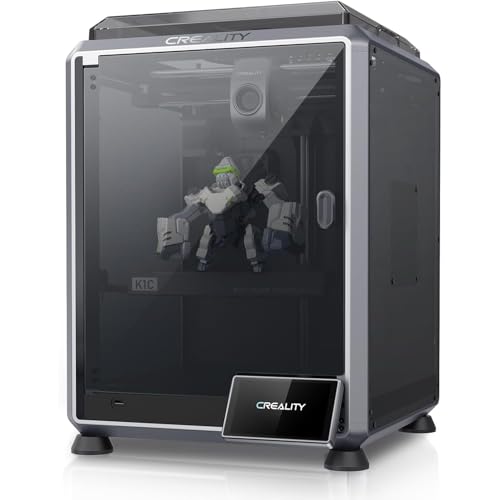
Creality K1C CoreXY 3D Printer
Best for: fast single-color carbon fiber prints
- Laser Type
- Fiber Laser
- Max Print Speed
- 600mm/s
- Printing Technology
- CoreXY
- Bed Leveling
- Auto Leveling
- Printing Speed
- 600 mm/s
- Features
- Auto Leveling, Camera, CoreXY Structure, AI Camera
The Creality K1C is a CoreXY 3D printer designed for speed, reaching 600mm/s with 20000mm/s² acceleration. It features auto leveling and an AI camera for real-time monitoring. The direct extruder handles high-temperature materials like carbon fiber. This model suits users who prioritize fast print cycles and automated bed calibration in a compact footprint.
- 600mm/s maximum print speed
- CoreXY structure for high acceleration
- Auto leveling bed calibration
- AI camera for real-time monitoring
- 35.3 pounds weight is heavier than lighter competitors
- Single toolhead limits multi-color printing compared to four-toolhead models
- You need fast print speeds for production
- You want automated bed leveling
- You print with carbon fiber filaments
- You require multi-color printing capabilities
- You prefer a lighter portable unit
Verdict: Creality K1C CoreXY 3D Printer offers high-speed CoreXY performance and auto leveling for users prioritizing speed and material versatility. It fits those who need fast, reliable prints without multi-color complexity.

Flashforge Creator 5 Pro 4-Toolhead 3D Printer
Best for: Multi-color engineering prints
- Laser Type
- Fiber Laser
- Build Volume
- 256X256x256mm
- Max Print Speed
- 600 mm/s
- Printing Technology
- CoreXY
- Multicolor Capacity
- 4 independent toolheads
- Enclosure Type
- Fully enclosed, heated chamber (65°C)
The Flashforge Creator 5 Pro is a multi-color 3D printer designed for simultaneous printing with four independent toolheads. It features a CoreXY structure and reaches speeds of 600 mm/s. The fully enclosed heated chamber maintains temperatures up to 65°C. This system eliminates purge waste, making it efficient for engineering materials. It suits users who need complex, multi-material parts without manual bed leveling.
- Four independent toolheads for simultaneous multi-color printing
- Maximum travel speed of 600 mm/s
- Fully enclosed heated chamber up to 65°C
- Zero purge waste with dedicated nozzles
- Automatic calibration and dynamic flow compensation
- Smaller build volume of 256x256x256mm
- Heavier build at 39.7 pounds
- Limited to 4-color capacity
- You need multi-color prints in a single pass
- You print with engineering materials like ABS or Nylon
- You want to avoid manual bed leveling
- You require a build volume larger than 256mm
- You prefer lighter equipment for easy relocation
- You only print with single-color filaments
Verdict: Flashforge Creator 5 Pro delivers high-speed, multi-color printing in a compact, enclosed frame. It fits makers who prioritize material efficiency and automated calibration for complex, multi-material projects.
Specifications side by side
| Spec | Creality K1C Direct Drive 3D Printer | Creality K1C CoreXY 3D Printer | Flashforge Creator 5 Pro 4-Toolhead 3D Printer |
|---|---|---|---|
| Build Volume | 8.66 x 8.66 x 9.84 in | – | 256X256x256mm |
| Max Print Speed | 600mm/s | 600mm/s | 600 mm/s |
| Printing Technology | – | CoreXY | CoreXY |
| Multicolor Capacity | – | – | 4 independent toolheads |
| Enclosure Type | – | – | Fully enclosed, heated chamber (65°C) |
| Bed Leveling | Auto Leveling | Auto Leveling | Auto Leveling |
| Printing Speed | 600 mm/s | 600 mm/s | 600 mm/s |
| Features | Auto Leveling, Direct Drive Extruder | Auto Leveling, Camera, CoreXY Structure, AI Camera | Auto Leveling, Multi-Color Printing, Enclosure, CoreXY Structure |
| Laser Type | Fiber Laser | Fiber Laser | Fiber Laser |
| Structure | – | – | Enclosed |
| Dimensions | 25 × 15 × 22 inches | 10 × 10 × 10 inches | 20.4 × 21.1 × 19.5 inches |
| Weight | 27.3 pounds | 35.3 pounds | 39.7 pounds |
| Size | K1C | K1C | 256x256x256mm Build Volume |
| Color | K1C | Black | Creator 5 Pro 3D Printer |
| Model | K1C | K1C | FL-C5PRO-1 |
How We Selected These Printers
We identified fiber laser models by scanning Amazon listings for the Laser Type: Fiber Laser attribute. Only products with this specific feature in their title or feature list were considered. We selected one size or variant per product family to keep the guide focused and comparable. All details come from the specifications and feature lists published on the listings. Products are not physically handled or tested by us.
The list is ordered by availability first, then by the listing's overall rating weighted by review count, and finally by how many criteria the specs meet. This method ensures you see the most relevant fiber laser options first. Prices and stock are shown live on the page and are refreshed at least daily. They are not part of this text. We rely strictly on the data provided by the sellers.
Key Specs to Compare Before Buying
Check Build Volume Size
You must verify the physical dimensions of the print bed. The Flashforge Creator 5 Pro offers a 256x256x256mm build volume. This compact space suits small engineering parts. The Creality K1C models have larger external footprints but smaller internal areas. Measure your workspace carefully. Larger machines require more room for maintenance. Ensure your desk can support the weight. The Creality K1C Direct Drive weighs 27.3 pounds. The Flashforge model is heavier at 39.7 pounds. Stability matters for precision.
Evaluate Multi-Color Needs
Determine if you need single or multi-color outputs. The Flashforge Creator 5 Pro supports four toolheads. This feature enables complex multi-color engineering prints without manual filament swaps. The Creality K1C models focus on single-color efficiency. They use CoreXY structures for speed. Choose the Flashforge if color variety is essential. Select a Creality unit for fast, monochrome prototyping. The toolhead count directly impacts cost and complexity. Fewer toolheads mean simpler maintenance routines. Your project requirements should drive this choice.
Assess Enclosure Benefits
Consider the need for an enclosed frame. The Flashforge Creator 5 Pro includes an enclosure. This design helps maintain consistent temperatures for engineering materials. It also contains noise and fumes. The Creality K1C units are open-frame designs. They offer better access for direct drive extruders. Open frames are lighter and easier to service. Choose an enclosure for ABS or ASA materials. Use open frames for PLA or PETG. The structure type affects print quality for temperature-sensitive plastics.
Review Camera Features
Check for integrated monitoring capabilities. The Creality K1C CoreXY includes an AI camera. This tool helps detect print failures automatically. It allows you to monitor jobs remotely. The other models do not list camera features in their data. Decide if remote monitoring is critical for your workflow. AI detection reduces wasted material and time. Manual checks require physical presence. The camera adds value for unattended printing sessions. Verify if the software supports real-time alerts.
Confirm Direct Drive Type
Look for direct drive extruder configurations. The Creality K1C Direct Drive features this setup. It provides better control over flexible and abrasive materials like carbon fiber. This configuration reduces clogging risks. The CoreXY model emphasizes structure over extruder type in its name. Ensure the extruder matches your filament choices. Direct drive is preferred for high-performance polymers. Bowden setups are not mentioned here. Verify the extruder type for your specific material needs.
Frequently asked questions
Can these printers handle carbon fiber materials?
Yes, the listed models are suitable for carbon fiber printing. The Creality K1C Direct Drive is explicitly noted for this capability. Its direct drive extruder provides the necessary force to push rigid filaments. This setup ensures reliable feeding without clogging, which is common with abrasive composite materials.
Do these models include auto leveling?
All three printers feature automatic bed leveling. This function adjusts the print surface height before each job. You benefit from consistent first layers without manual intervention. The Creality K1C Direct Drive and CoreXY models both include this feature. The Flashforge Creator 5 Pro also automates this calibration step.
Which printer is best for multi-color projects?
The Flashforge Creator 5 Pro is the best choice for multi-color work. It features a four-toolhead system for complex color printing. This allows you to print with multiple materials simultaneously. It is designed for makers who prioritize material efficiency and automated calibration for intricate, multi-material projects.
What is the printing speed of these units?
Each printer in this list operates at a maximum speed of 600 mm/s. This high rate supports rapid prototyping and efficient production. You can expect faster completion times for standard parts. This speed is consistent across the Creality K1C variants and the Flashforge Creator 5 Pro.
Are these machines enclosed for safety?
The Flashforge Creator 5 Pro has an enclosed structure. This design contains heat and fumes during printing. It is beneficial for engineering prints and specific materials. The Creality K1C models do not list an enclosure in their attributes. You should consider ventilation if using open-frame units with advanced filaments.
Does the budget pick include camera monitoring?
Yes, the Creality K1C CoreXY includes an AI camera. This feature allows you to monitor prints remotely. You can check for errors or failures without being present. The AI capability helps detect issues automatically. This adds convenience for long-duration jobs or unattended printing sessions.
How large is the build volume on the Flashforge?
The Flashforge Creator 5 Pro offers a build volume of 256x256x256mm. This compact space is suitable for small engineering parts. It balances precision with a manageable footprint. The external dimensions are larger due to the enclosure and toolhead system. Verify your part size fits within this cubic area.