8 Best 3d Printers Under $1500, Compared
As Amazon Associates, we earn from qualifying purchases. This means we may receive a small commission at no extra cost to you if you click through and make a purchase.
As an Amazon Associate we earn from qualifying purchases. Links on this page are affiliate links.
Finding the best 3d printers under $1500 requires looking at published specs rather than marketing claims. We compared 8 models to help you choose. The QIDI Max4 Combo Large 3D Printer leads this list. It is best for large industrial parts and high-temp materials. Its 120-pound weight and 28-inch width indicate a robust, enclosed frame built for stability. These picks are based strictly on the specifications published on the listings. This guide helps you decide which machine fits your workspace and material needs.
Choose printing technology first
Your choice depends on material. FDM printers like the QIDI Max4 and Prusa MK4S handle engineering filaments and large parts. Resin models such as the Uniformation GK3 and HALOT-MAGE Pro offer high detail for small prototypes. Select FDM for strength and size. Pick resin for precision and fine features. Check the build volume to ensure the machine fits your workspace.
| # | Product | Best for | Price |
|---|---|---|---|
| 1 | QIDI Max4 Combo Large 3D Printer Best overall | large industrial parts and high-temp materials | |
| 2 | Original Prusa CORE One+ CoreXY DIY Kit Best premium | builders needing secure, high-speed printing | |
| 3 | Uniformation GK3 13.5-Inch 16K Resin Printer Best budget | large format high-detail resin prototyping | |
| 4 | Original Prusa MK4S 3D Printer Best fdm | Reliable high-speed FDM prototyping and production | |
| 5 | Original Prusa CORE One CoreXY 3D Printer Also great | reliable enclosed printing with CoreXY speed | |
| 6 | Snapmaker Artisan Dual Extrusion 3D Printer Best touchscreen | Large format dual extrusion printing | |
| 7 | ANYCUBIC Photon P1 Max Resin Printer Also great | Large batch resin printing | |
| 8 | VFDIOAIOFURRE HALOT-MAGE Pro 8K Resin Printer Best lcd | High-detail resin printing with 8K resolution |
The best fit for you
- You need large industrial parts and high-temp materials – QIDI Max4 Combo Large 3D Printer – It features a 28x28x30 inch build volume and enclosed design for engineering-grade filaments.
- You want reliable high-speed FDM prototyping and production – Original Prusa MK4S 3D Printer – This FDM printer offers professional-grade reliability and speed in a compact 15.7×19.6×21.6 inch footprint.
- You seek large format high-detail resin prototyping – Uniformation GK3 13.5-Inch 16K Resin Printer – It provides a 16K screen resolution and automatic resin management for precision continuous printing.
- You prioritize a large 400 mm cube build volume – Snapmaker Artisan Dual Extrusion 3D Printer – It supports dual extrusion and features a 7-inch touchscreen for multi-color work.
- You need high XY resolution for detailed resin models – VFDIOAIOFURRE HALOT-MAGE Pro 8K Resin Printer – It delivers 8K LCD resolution, though its 228x128x230 mm volume suits small projects.
Trade-offs in this price range
Printers under $1500 balance capability with cost. You get professional features like enclosed designs and auto-leveling. However, you may sacrifice raw speed or massive build volumes. Resin models offer high screen resolution but lack the strength of FDM parts. DIY kits require assembly time. Large formats often mean heavier units. You choose based on your primary material and detail needs.
- FDM printers like the QIDI Max4 offer large build volumes but weigh up to 120 pounds.
- Resin models provide high screen resolution, such as 16K or 8K, but have smaller print areas.
- DIY kits like the Prusa CORE One+ require assembly, saving money but adding setup time.
- Enclosed designs ensure stability but may limit the maximum part size compared to open frames.
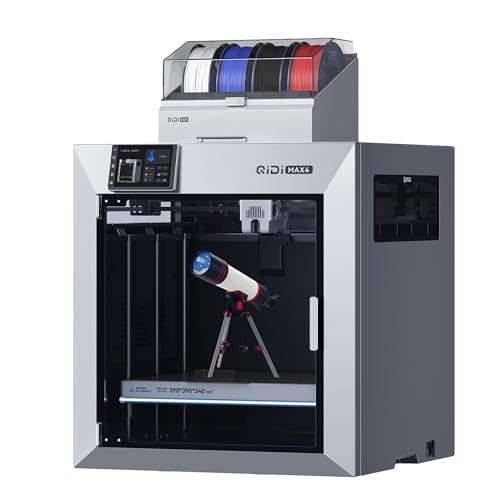
QIDI Max4 Combo Large 3D Printer
Best for: large industrial parts and high-temp materials
- Build Volume
- 390×390×340mm
- Max Print Speed
- 800mm/s
- Multicolor Capacity
- 16-color
- Enclosure Type
- 65℃ active heated chamber
- Bed Leveling
- auto-leveling
- Features
- Auto Leveling, Camera, AI Camera
The QIDI Max4 Combo offers a 390×390×340mm build volume and an active heated chamber reaching 65°C. It features dual Z lead screws and closed-loop motors for stability. The printer supports speeds up to 800mm/s and includes an AI camera for monitoring. It is designed for users who need to print large, complex parts or use industrial materials like carbon fiber-reinforced nylon.
- 390×390×340mm build volume for large parts
- 65°C active heated chamber for high-temp materials
- 800mm/s max print speed with 30,000mm/s² acceleration
- Dual Z lead screws for improved precision
- Built-in AI camera detects printing failures
- Heavy 120-pound build requires sturdy support
- Large footprint of 28x28x30 inches takes up space
- Polar Cooler system must be purchased separately
- You need to print large industrial parts in one go
- You work with high-temperature materials like ABS-CF or PC
- You want multi-color printing with up to 16 colors
- You have limited desk space for a 28-inch wide printer
- You only print small PLA models and do not need a heated chamber
- You prefer a lighter, more portable desktop printer
Verdict: QIDI Max4 Combo 3D Printer is the right choice for professionals who need a large, enclosed workspace for engineering-grade filaments. It suits users who prioritize speed and stability for big projects over compact size.

Original Prusa CORE One+ CoreXY DIY Kit
Best for: builders needing secure, high-speed printing
- Printing Technology
- CoreXY
- Enclosure Type
- Fully Enclosed
- Features
- Enclosure, CoreXY Structure
- Target Audience
- Beginners
- Application
- DIY Projects
- Dimensions
- 16.3 × 17.5 × 21.8 inches
The Original Prusa CORE One+ is a high-speed CoreXY 3D printer kit designed for users who prefer building their own machines. It features a fully enclosed chamber that reaches 55°C, allowing for reliable printing with engineering materials like carbon fiber and nylon. The all-steel exoskeleton frame ensures stability during rapid prints. This offline-capable system keeps your designs secure, making it suitable for professional environments or users who value data privacy over cloud connectivity.
- CoreXY printing technology for high-speed operation
- Fully enclosed chamber with active thermal control up to 55°C
- 100% offline-capable with removable Wi-Fi module for secure operation
- All-steel exoskeleton frame for maximum stability
- Requires 15–20 hours of assembly time for the DIY kit version
- Heavier build at 54 pounds compared to lighter desktop options
- Smaller enclosed chamber temperature limit of 55°C versus higher specs in other list items
- You want to build your printer yourself for a deeper technical understanding
- You need to print high-temperature materials like nylon or carbon fiber
- You prefer offline operation to keep your designs secure
- You want a ready-to-use machine without assembly
- You need a larger build volume than the CORE One offers
- You prefer cloud-based printing and remote management
Verdict: Original Prusa CORE One+ DIY Enclosed is a solid choice for builders who value stability and secure, offline printing. It suits those willing to invest time in assembly to gain a professional-grade machine for engineering materials.
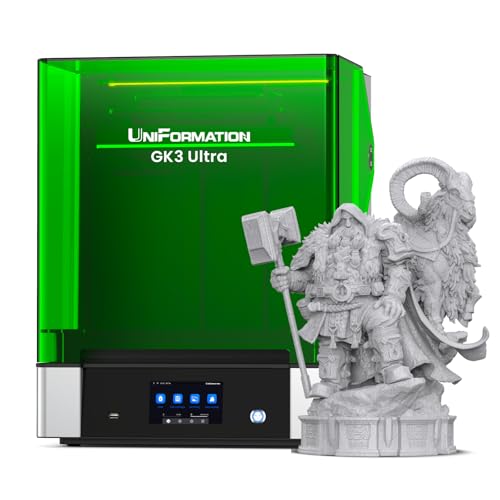
Uniformation GK3 13.5-Inch 16K Resin Printer
Best for: large format high-detail resin prototyping
- Build Volume
- 300 × 160 × 300mm
- Printing Technology
- Resin
- Screen Resolution
- 16K
- Dimensions
- 19 × 21 × 26 inches
The Uniformation GK3 Ultra is a 16K resin 3D printer with a 300 × 160 × 300mm build volume. It features automatic resin heating and feeding to support continuous large prints. The integrated KK60 module ensures stable Z-axis movement with ±0.003mm accuracy. This machine suits users who need high detail and a large print area for industrial prototyping or studio work.
- 16K LCD screen resolution for sharp details
- 300 × 160 × 300mm large build volume
- Automatic resin heating system for cold climates
- Built-in automatic resin feeder for continuous prints
- ±0.003mm repeat positioning accuracy
- 160mm Z-axis height limits vertical print size compared to competitors
- 21 × 26 × 19 inch footprint requires significant desk space
- You need a large build volume for resin printing
- You want automatic resin heating for consistent results
- You require high-resolution 16K detail for prototyping
- You prefer FDM printing technology over resin
- You need a build volume taller than 160mm
- You have limited desk space for a bulky machine
Verdict: The Uniformation GK3 Ultra Resin Printer is a high-detail option for users who need a large 16K print area and automatic resin management. It fits professionals who prioritize precision and continuous printing capabilities over vertical height.

Original Prusa MK4S 3D Printer
Best for: Reliable high-speed FDM prototyping and production
- Build Volume
- 9.84 x 8.3 x 8.6 in
- Printing Technology
- FDM
- Dimensions
- 19.6 × 15.7 × 21.6 inches
- Weight
- 15.4 pounds
The Original Prusa MK4S is a fully assembled high-speed FDM printer with a 9.84 x 8.3 x 8.6 inch build volume. It features input shaping to reduce ringing and vibrations, ensuring sharp edges at higher speeds. The system is open-source and upgradeable, designed for consistent daily operation. It includes a 1 kg spool of PLA filament and lifetime technical assistance, making it suitable for workshops and studios.
- Fully assembled for immediate use
- Input shaping reduces ringing and vibrations
- Open-source and upgradeable ecosystem
- Includes 1 kg PLA filament
- Smaller 9.84 x 8.3 x 8.6 inch build volume compared to competitors
- Heavier 15.4 pound weight than many desktop alternatives
- Lower maximum heated bed temperature than high-temp FDM models
- You need a reliable, fully assembled FDM printer for daily use
- You value open-source hardware and long-term upgrade paths
- You prioritize print quality and speed over large build volumes
- You require a build volume larger than 9.84 x 8.3 x 8.6 inches
- You prefer a resin-based printing technology for high detail
- You want a DIY kit to save on upfront assembly
Verdict: Original Prusa MK4S FDM Desktop Printer offers professional-grade reliability and speed for users who need consistent output in a compact footprint. It fits those who value open-source flexibility and immediate usability over sheer size.

Original Prusa CORE One CoreXY 3D Printer
Best for: reliable enclosed printing with CoreXY speed
- Build Volume
- 250 x 220 x 270 mm
- Printing Technology
- CoreXY
- Enclosure Type
- Enclosed, heated up to 55 °C
- Dimensions
- 16.3 × 17.5 × 21.8 inches
- Weight
- 56.9 pounds
The Prusa CORE One is a CoreXY 3D printer with a 250 x 220 x 270 mm build volume. It features an enclosed heated chamber that reaches 55 °C for stable printing. This assembled unit includes a 1 kg spool of PLA filament. It suits users who need reliable performance with minimal maintenance. The design prioritizes firmness and robustness for consistent results.
- CoreXY printing technology for high-speed and high-quality output
- Enclosed heated chamber reaches 55 °C for material stability
- All-steel exoskeleton frame provides maximum firmness
- Comes fully assembled and tested for immediate use
- 250 x 220 x 270 mm build volume is smaller than competitors like the Snapmaker Artisan
- 56.9 pounds weight is heavier than many desktop alternatives
- Heated chamber maxes out at 55 °C, lower than the QIDI Max4's 65 °C
- You need an enclosed printer for materials like ASA or Nylon
- You prefer a fully assembled unit ready to print immediately
- You require a build volume larger than 250 mm in any dimension
- You want a printer lighter than 50 pounds for easy transport
Verdict: The Prusa CORE One Enclosed 3D Printer fits professionals who value robust construction and reliable CoreXY performance over maximum build size. Its enclosed design ensures consistent results for advanced materials.

Snapmaker Artisan Dual Extrusion 3D Printer
Best for: Large format dual extrusion printing
- Build Volume
- 400 x 400 x 400 mm
- Multicolor Capacity
- Dual Extrusion
- Bed Leveling
- Auto Bed Leveling
- Features
- Auto Leveling, Touchscreen, Dual Extruder
- Dimensions
- 24.4 × 22.8 × 25 inches
The Snapmaker Artisan 3D Printer offers a 400 x 400 x 400 mm build volume for large projects. It features dual extrusion for multi-color printing and uses industrial-grade steel guiderails for precision. A 7-inch touchscreen simplifies operation by allowing you to view live status and adjust settings easily. This machine suits users who need a large working area and reliable performance for daily or professional needs.
- 400 x 400 x 400 mm build volume
- Dual extrusion for multi-color printing
- 7-inch touchscreen interface
- Industrial-grade steel guiderails
- Larger physical footprint at 24.4 x 22.8 x 25 inches
- Dual extrusion limits color options compared to triple systems
- You need a large build volume for complex projects
- You want a large touchscreen for easier navigation
- You require dual extrusion for multi-material prints
- You have limited desk space due to its large size
- You only need single-color printing
- You prefer a smaller desktop footprint
Verdict: Snapmaker Artisan 400mm 3D Printer fits makers who prioritize a large 400 mm cube build volume and a clear 7-inch touchscreen. Its dual extrusion and rigid steel frame support detailed, multi-color work in a stable setup.

ANYCUBIC Photon P1 Max Resin Printer
Best for: Large batch resin printing
- Build Volume
- 11.24×8.43×11.81 inches
- Printing Technology
- Resin
- Bed Leveling
- Auto-Leveling 3.0
The ANYCUBIC Photon P1 Max is a resin 3D printer with a 11.24×8.43×11.81 inch build volume. It features a 14-inch 12K screen and LighTurbo 3.0 light engine for high precision. Auto-Leveling 3.0 calibrates before each print. The heated resin vat maintains temperature for consistent results. AI monitoring detects issues early. This bundle includes the Wash & Cure Max 3.0 station.
- 18.3L build volume for large batches
- 14-inch 12K screen resolution
- Heated resin vat up to 35°C
- Auto-Leveling 3.0 system
- AI print monitoring
- Smaller build volume than the 390mm and 400mm printers on this list
- Resin printing requires more post-processing than FDM
- 1.9L tank capacity limits resin volume per batch
- You need to print large resin models or many small parts at once
- You want high precision with ±0.01mm accuracy
- You print in cold environments and need temperature control
- You prefer FDM printing with filament
- You need a build volume larger than 11.24 inches
- You want to avoid resin handling and post-processing
Verdict: ANYCUBIC Photon P1 Max Resin Printer suits users scaling up resin production with large batches. It fits those who value precision and automated leveling over raw speed or FDM simplicity.

VFDIOAIOFURRE HALOT-MAGE Pro 8K Resin Printer
Best for: High-detail resin printing with 8K resolution
- Build Volume
- 228 x 128 x 230 mm
- Printing Technology
- LCD Photocuring Resin
- Screen Resolution
- 8K
The HALOT-MAGE Pro is an LCD photocuring resin printer designed for detailed model creation. It features an 8K monochrome screen with 29.7μm XY resolution and a 10.3-inch display. The build volume measures 228 x 128 x 230 mm, offering about 45% more space than standard 8.9-inch resin printers. This setup suits you if you need high precision and a moderate footprint for resin printing tasks.
- 8K monochrome LCD screen delivers 29.7μm XY resolution
- 10.3-inch display provides a 228 x 128 x 230 mm build volume
- LCD photocuring technology ensures high-detail prints
- Build space is 45% larger than 8.9-inch resin printers
- Z-axis build height of 230 mm is lower than the 340 mm height of the QIDI Max4
- Build volume depth of 128 mm is narrower than the 390 mm depth of the QIDI Max4
- X-axis width of 228 mm is smaller than the 390 mm width of the QIDI Max4
- You require high-resolution details for small-scale models
- You need a dedicated resin printer with a moderate build size
- You prioritize XY resolution over large vertical build height
- You need to print large objects requiring a wider build area
- You prefer FDM printing for larger, less detailed parts
- You want a build height exceeding 230 mm
Verdict: The VFDIOAIOFURRE HALOT-MAGE Pro 8K Resin Printer fits users who need high XY resolution for detailed resin models. Its 228 x 128 x 230 mm volume suits small to medium projects rather than large-scale printing.
Specifications side by side
| Spec | QIDI Max4 Combo Large 3D Printer | Original Prusa CORE One+ CoreXY DIY Kit | Uniformation GK3 13.5-Inch 16K Resin Printer | Original Prusa MK4S 3D Printer | Original Prusa CORE One CoreXY 3D Printer | Snapmaker Artisan Dual Extrusion 3D Printer | ANYCUBIC Photon P1 Max Resin Printer | VFDIOAIOFURRE HALOT-MAGE Pro 8K Resin Printer |
|---|---|---|---|---|---|---|---|---|
| Build Volume | 390×390×340mm | – | 300 × 160 × 300mm | 9.84 x 8.3 x 8.6 in | 250 x 220 x 270 mm | 400 x 400 x 400 mm | 11.24×8.43×11.81 inches | 228 x 128 x 230 mm |
| Max Print Speed | 800mm/s | – | – | – | – | – | – | – |
| Printing Technology | – | CoreXY | – | FDM | CoreXY | – | Resin | LCD Photocuring Resin |
| Multicolor Capacity | 16-color | – | – | – | – | Dual Extrusion | – | – |
| Enclosure Type | 65℃ active heated chamber | Fully Enclosed | – | – | Enclosed, heated up to 55 °C | – | – | – |
| Bed Leveling | auto-leveling | – | – | – | – | Auto Bed Leveling | Auto-Leveling 3.0 | – |
| Screen Resolution | – | – | 16K | – | – | – | – | 8K |
| Features | Auto Leveling, Camera, AI Camera | Enclosure, CoreXY Structure | – | – | – | Auto Leveling, Touchscreen, Dual Extruder | – | – |
| Target Audience | – | Beginners | – | – | – | – | – | – |
| Application | – | DIY Projects | – | – | – | – | – | – |
| Structure | – | Enclosed | – | – | – | – | – | – |
| Dimensions | 28 × 28 × 30 inches | 16.3 × 17.5 × 21.8 inches | 19 × 21 × 26 inches | 19.6 × 15.7 × 21.6 inches | 16.3 × 17.5 × 21.8 inches | 24.4 × 22.8 × 25 inches | – | – |
| Weight | 120 pounds | 54 pounds | – | 15.4 pounds | 56.9 pounds | – | – | – |
| Size | MAX4 Combo | – | – | – | – | Large | – | – |
| Color | Grey | Orange | black | Black Orange | Black | Black | – | – |
| Model | – | Original Prusa CORE One+ kit | GK3 Ultra | MK4S-COM-PEI | B0FCFKYXYS | Artisan 3DP | – | – |
How we picked these 3d printers
We selected 8 models from Amazon listings priced under $1500. The list orders products by availability first, then by overall rating weighted by review count, and finally by how well the specs match your needs. We show only one size or variant per product family. Every detail comes directly from the published specifications and feature lists on the product pages. We do not handle the hardware or perform independent testing. Prices and stock levels update live on the page and refresh at least daily. A printer stays in this guide only while its current price remains under $1500. As prices change, items may move in or out of the list. You can trust that the rankings reflect current data, not static reviews. This method ensures you see the most relevant options for your budget and project requirements.
How to choose the right 3d printer
Select printing technology
Decide between FDM and resin printing based on your material needs. FDM printers like the QIDI Max4 Combo and Original Prusa MK4S handle engineering-grade filaments and produce strong, functional parts. They are ideal for large industrial components. Resin models such as the Uniformation GK3 and ANYCUBIC Photon P1 Max offer high detail for small prototypes. Choose FDM for strength and speed. Choose resin for precision and smooth surface finishes on smaller objects. Your material choice dictates the machine type.
Check build volume size
Verify the physical dimensions of the build area to ensure it fits your projects. The QIDI Max4 Combo offers a massive 28x28x30 inch workspace for large parts. The Snapmaker Artisan provides a 400mm cube volume for substantial dual extrusion work. Smaller printers like the Original Prusa MK4S have a compact 15.7×19.6×21.6 inch footprint. Measure your largest intended object before buying. Ensure the printer fits in your designated workspace as well. Size impacts both print capacity and room requirements.
Review screen resolution
Screen resolution determines the level of detail in resin prints. The Uniformation GK3 features a 16K screen for extreme precision. The HALOT-MAGE Pro uses an 8K screen for high XY resolution. These models suit users needing fine details for small prototypes. FDM printers do not use screen resolution in the same way. They rely on nozzle size and layer height. If you print miniature figures or intricate jewelry, prioritize high screen resolution. For functional parts, focus on material strength and build volume instead.
Evaluate printer features
Look for automation features that reduce manual setup time. The QIDI Max4 Combo includes auto leveling and an AI camera. The Snapmaker Artisan offers a clear 7-inch touchscreen and dual extrusion. Auto leveling ensures consistent first layers without manual adjustment. Dual extrusion allows for multi-color or support material printing. The Original Prusa CORE One+ includes an enclosure for stable printing. These features enhance reliability. Choose based on how much manual intervention you want to avoid during the printing process.
Consider assembly requirements
Some printers arrive as DIY kits requiring assembly. The Original Prusa CORE One+ is sold as a DIY kit. This option suits builders who value stability and are willing to invest time in assembly. It results in a professional-grade machine for engineering materials. Other models arrive fully assembled and ready to use. The Original Prusa MK4S offers immediate usability. Decide if you enjoy building hardware or prefer a plug-and-play experience. Assembly time affects when you can start printing your first project.
Frequently asked questions
Which 3d printer is best for large industrial parts?
The QIDI Max4 Combo is the top choice for large industrial parts. It features a massive 28x28x30 inch build volume. This enclosed design supports high-temperature engineering filaments. It includes auto-leveling and an AI camera for stability. This machine suits professionals who prioritize speed and workspace size over compact dimensions.
What is the best budget resin printer option?
The Uniformation GK3 16K Resin Printer is the best budget option. It offers a large 13.5-inch 16K print area for high-detail prototyping. This model focuses on precision and continuous printing capabilities. It is ideal for users who need large format resin output without sacrificing vertical height or resolution.
Which printer offers the best touchscreen experience?
The Snapmaker Artisan Dual Extrusion 3D Printer provides the best touchscreen experience. It features a clear 7-inch display for easy navigation. This large format machine supports dual extrusion for multi-color work. Its rigid steel frame ensures stability during detailed printing tasks in a stable setup.
Is there a CoreXY printer for beginners?
The Original Prusa CORE One+ CoreXY DIY Kit is suitable for beginners. It features a secure, enclosed CoreXY structure for high-speed printing. You must assemble this kit, which offers professional-grade results for engineering materials. It is a solid choice for builders who value stability and offline printing capabilities.
Which FDM printer is best for reliable prototyping?
The Original Prusa MK4S is best for reliable high-speed FDM prototyping. It delivers professional-grade reliability in a compact 15.7×19.6×21.6 inch footprint. This model offers open-source flexibility and immediate usability. It suits users who need consistent output for production rather than sheer build volume size.
What is the best 8K resin printer?
The VFDIOAIOFURRE HALOT-MAGE Pro is the best 8K resin printer. It delivers high XY resolution for detailed models. The 228 x 128 x 230 mm volume suits small to medium projects. This LCD-based machine is designed for users who need high detail for resin models rather than large-scale printing.