3d Scanners Buying Guide (2026): What Matters and 8 Picks
As Amazon Associates, we earn from qualifying purchases. This means we may receive a small commission at no extra cost to you if you click through and make a purchase.
As an Amazon Associate we earn from qualifying purchases. Links on this page are affiliate links.
This 3d scanner buying guide helps you choose the right device for your specific needs. You will learn how to evaluate key specifications like accuracy, light source type, and connectivity options. These factors determine whether a scanner suits outdoor use, industrial inspection, or casual hobby projects. We focus strictly on published technical data to ensure objective comparisons.
We selected 8 top-rated models based on their documented performance metrics. The list includes options for high-precision metrology, portable wireless scanning, and safe face capture. Each recommendation highlights distinct advantages, such as 0.02mm accuracy or full-color capture capabilities. By understanding these specs, you can decide which tool fits your workflow. The following sections detail the technical attributes that matter most for your intended applications.
Key Specs for Choosing 3D Scanners
Accuracy and precision levels
Accuracy defines how closely the digital model matches the physical object. You should look for values like 0.02mm or 0.03mm depending on your needs. Higher precision suits industrial inspection and reverse engineering, where small details matter. Lower precision may suffice for casual hobby projects or prototyping. The Revopoint POP 4 Premium offers 0.03mm accuracy, which balances detail with versatility. The Creality CR-Scan Raptor Pro provides 0.02mm accuracy for stricter requirements. Consider whether your workflow demands metrology-grade results or just visual representation. Higher accuracy often correlates with higher cost and stricter lighting conditions. Evaluate the tolerance your final print or analysis requires before selecting a device.
Look for
- 0.02mm for industrial precision
- 0.03mm for general detail
Light source technology type
The light source determines how the scanner captures surface data. Blue laser scanners penetrate dark surfaces and work well outdoors. Structured light is effective for indoor use and complex geometries. Some devices combine both, offering flexibility across different environments. The Creality CR-Scan Raptor Pro uses blue laser and structured light for versatile performance. The Revopoint INSPIRE 2 relies on structured light, which is safe and effective for small objects. Blue lasers can be more sensitive to ambient light, affecting outdoor scans. Structured light may struggle with highly reflective or black surfaces. Choose based on where you plan to scan most often and the materials you handle.
Look for
- Blue laser for dark surfaces
- Structured light for indoors
Color capture capability
Full-color scanning adds visual texture to your 3D models, making them realistic for visualization or presentation. This feature is essential if you need to document artifacts or create visually accurate replicas. Not all scanners support color capture, so check the specifications carefully. The Creality CR-Scan Ferret Pro and Revopoint INSPIRE 2 both offer full-color scanning. Devices without this feature produce monochrome meshes, which are sufficient for functional prototyping. Color data increases file size and processing time. Decide if visual fidelity is critical for your end use. For purely functional parts, color may be unnecessary overhead.
Look for
- Full-color scanning support
- Monochrome only for function
Wireless and connectivity options
Connectivity affects workflow flexibility and setup complexity. Wireless scanners allow you to move freely without cable constraints, which is useful for large objects or outdoor scanning. Wi-Fi 6 offers faster data transfer rates for high-resolution scans. The Creality Pika Portable uses Wi-Fi 6 for efficient performance. The Revopoint MetroY Ultra is wireless, enhancing mobility. Wired connections provide stable power and consistent data transmission, which some professionals prefer for critical tasks. Check if the device supports your preferred connection method. Wireless convenience may come with battery life limitations. Evaluate your need for mobility versus stable, tethered operation.
Look for
- Wi-Fi 6 for speed
- Wireless for mobility
Operating system compatibility
Ensure the scanner works with your computer or mobile device. Compatibility lists vary by brand and model. Some scanners support Windows, macOS, iOS, and Android, offering broad flexibility. The Revopoint POP 4 Premium and INSPIRE 2 support all four major platforms. Others, like the Creality CR-Scan Raptor Pro, may be limited to Windows and macOS. Mobile support allows scanning on tablets or phones, useful for field work. Desktop-only devices require a dedicated computer. Check system requirements for processing power, as high-resolution scans demand significant resources. Mismatched compatibility can halt your workflow entirely.
Look for
- Windows and macOS support
- iOS and Android options
Portability and physical size
The physical dimensions and weight of the scanner impact usability. Pocket-sized devices are ideal for on-the-go scanning and small object documentation. The Revopoint INSPIRE 2 weighs only 6.7 ounces, making it highly portable. The Creality Pika Portable is also lightweight at 9.12 ounces. Larger devices, like the Creality CR-Scan Raptor Pro, offer robust features but require more handling space. Consider how you will carry and operate the device. Heavy scanners may cause fatigue during long sessions. Compact designs suit travel and quick scans. Balance portability with the feature set you require for your specific tasks.
Look for
- Under 10 ounces for portability
- Compact form factor
Specialized features and tracking
Advanced features like anti-shake tracking and marker-free scanning improve ease of use and result consistency. Anti-shake tracking compensates for hand movement, ensuring smoother scans without manual stabilization. The Creality CR-Scan Ferret Pro and Revopoint MetroY Ultra include this feature. Marker-free tracking reduces setup time by eliminating the need for physical markers on objects. The Creality Pika Portable supports marker-free operation. These features are valuable for beginners or users scanning complex geometries. They reduce the learning curve and improve scan quality. Evaluate if these tools streamline your workflow or add unnecessary complexity for simple tasks.
Look for
- Anti-shake tracking support
- Marker-free scanning capability
Types of 3D Scanners
Blue Laser Scanners
Blue laser scanners use structured light and laser projection for high accuracy. Models like the Revopoint POP 4 Premium offer 0.03mm precision, while the Creality CR-Scan Raptor Pro achieves 0.02mm. These devices suit industrial inspection and reverse engineering where detail matters. They often support full-color scanning and anti-shake tracking. You need a capable PC for processing. They excel in controlled environments but can handle outdoor use with proper lighting. This type balances speed and metrology-grade results for professional workflows.
Wireless Portable Scanners
Wireless scanners prioritize mobility and ease of use. The Creality CR-Scan Ferret Pro and Revopoint INSPIRE 2 connect via Wi-Fi or wireless protocols. They fit beginners and users scanning medium objects in various locations. The Revopoint POP 4 Premium also supports wireless operation for outdoor tasks. You gain flexibility without cable constraints. However, wireless models may sacrifice some maximum precision compared to tethered industrial units. They are practical for field work, prototyping, and capturing complex geometries without a fixed workstation setup.
Specialized Compact Scanners
Compact scanners focus on specific applications like face scanning or small parts. The 3DMakerpro Fox NIR Scanner uses near-infrared light for safe face capture and markerless tracking. The Creality Pika Portable delivers 0.03mm accuracy in a pocket-sized form factor. These devices suit DIY prototyping and figurine scanning. You get high precision in a small package. The trade-off is limited scan volume for large objects. They require specific PC hardware and patience to learn the workflow. Ideal for users needing portability without compromising on fine detail capture.
Common 3D Scanner Mistakes
Ignoring accuracy specs
Accuracy defines how closely your digital model matches the physical object. You should look for values like 0.02mm or 0.03mm depending on your needs. Higher precision suits industrial inspection and reverse engineering, where small details matter. Check the published specs before buying.
Overlooking light source type
Blue laser scanners use structured light and laser projection for high accuracy. These devices suit industrial inspection and reverse engineering. Ensure the light source matches your material. Shiny or dark surfaces can reflect light differently, affecting the scan quality and final result.
Forgetting connectivity options
Connectivity determines how easily you transfer data to your computer. Check if the scanner supports USB, Wi-Fi, or Bluetooth. Wireless options offer flexibility but may have latency. Wired connections provide stable data transfer. Match the interface to your workflow and device capabilities.
Skipping calibration steps
Calibration ensures the scanner measures objects correctly. Many devices require initial setup or periodic recalibration. Skipping this step leads to distorted models. Follow the manufacturer's instructions carefully. Proper calibration maintains accuracy over time and ensures consistent results for your projects.
| # | Product | Best for | Price |
|---|---|---|---|
| 1 | Revopoint POP 4 Premium 3D Scanner | Outdoor scanning and complex object capture | |
| 2 | Creality CR-Scan Ferret Pro Wireless 3D Scanner | beginners scanning medium objects wirelessly | |
| 3 | Creality CR-Scan Raptor Pro | High-precision industrial and large object scanning | |
| 4 | Creality CR-Scan Raptor Blue Laser Scanner | High-precision industrial scanning with color | |
| 5 | 3DMakerpro Fox NIR Scanner | safe face scanning and DIY prototyping | |
| 6 | Revopoint MetroY Ultra 3D Scanner | Industrial inspection and reverse engineering | |
| 7 | Creality Pika Portable 3D Scanner | high-precision scanning of small parts and figurines | |
| 8 | Revopoint INSPIRE 2 Wireless 3D Scanner | portable outdoor scanning with color capture |
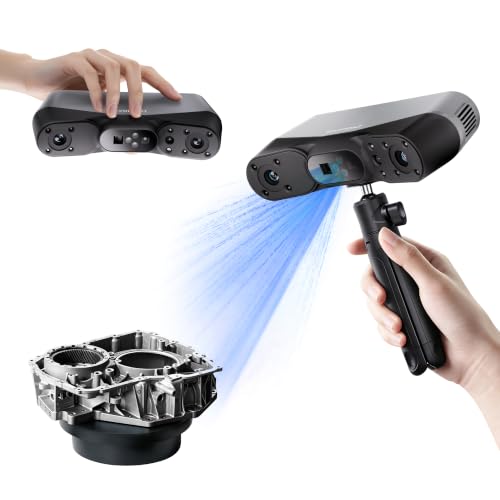
Revopoint POP 4 Premium 3D Scanner
Best for: Outdoor scanning and complex object capture
- Accuracy
- 0.03 mm
- Light Source
- Blue laser, NIR structured light, VCSEL
- Scan Speed
- Up to 105 fps
- Laser Line Count
- 30 cross lines, single-line
- Target Object Size
- 10x10x10 mm to 2x2x2 m
- Connectivity
- WiFi 6.0
The Revopoint POP 4 Premium delivers 0.03 mm accuracy and scans up to 105 fps using blue laser and NIR structured light. It handles objects from 10x10x10 mm to 2x2x2 m with five distinct scanning modes. You get WiFi 6.0 connectivity and a 5500mAh battery for up to four hours of outdoor use. This scanner suits professionals needing precise data capture in varied lighting conditions.
- 0.03 mm single-frame accuracy for fine detail
- Up to 105 fps scan speed with NVIDIA GPU acceleration
- Five scanning modes including VCSEL and 30-cross laser lines
- Operates reliably in up to 100,000 lux ambient light
- 5500mAh battery provides up to 4 hours of continuous scanning
- AI segmentation and professional software require Windows
- Revo Design and Revo Measure are paid add-ons
- 0.03 mm accuracy is lower than the 0.02 mm spec on the Creality CR-Scan Raptor
- You need to scan highly reflective metals or dark objects
- You work on construction sites or archaeological digs outdoors
- You require real-time cross-screen preview via WiFi 6.0
- You only have macOS or mobile devices for post-processing
- You want all software included without extra purchases
- You prioritize the highest possible accuracy over outdoor versatility
Verdict: The Revopoint POP 4 Premium 3D Scanner fits professionals who need reliable outdoor performance and versatile scanning modes for complex geometries.

Creality CR-Scan Ferret Pro Wireless 3D Scanner
Best for: beginners scanning medium objects wirelessly
- Accuracy
- 0.1mm
- Target Object Size
- 50mm to 2000mm
- Connectivity
- Wi-Fi 6
- Color Capture
- 24-bit full color
- Features
- Full-Color Scanning, Anti-Shake Tracking
- Compatible Operating System
- Windows, iOS, Android
The Creality CR-Scan Ferret Pro is a handheld 3D scanner designed for beginners and DIY creators. It captures full-color 24-bit models with 0.1mm accuracy. The device uses Wi-Fi 6 for stable wireless scanning across Windows, macOS, Android, and iOS. It handles objects between 50mm and 2000mm. This lightweight kit includes a tripod, power bank, and carrying case for portable use.
- Wi-Fi 6 wireless scanning for cross-platform flexibility
- 0.1mm accuracy for detailed full-color 24-bit models
- Lightweight 105g build for portable use
- Includes tripod, power bank, and carrying case
- 0.1mm accuracy is lower than competitors offering 0.02mm or 0.03mm
- Minimum scan size of 50mm excludes small jewelry or precision parts
- Struggles with reflective, transparent, or very dark surfaces
- You need a lightweight scanner for objects between 50mm and 2000mm
- You want wireless scanning on iOS or Android devices
- You are a beginner looking for an easy-to-use kit
- You require sub-0.03mm accuracy for fine details
- You need to scan small items under 50mm
- You frequently scan highly reflective or transparent objects
Verdict: The Creality CR-Scan Ferret Pro fits beginners who prioritize portability and wireless convenience over high-precision metrology. It is a practical tool for scanning medium-sized objects in various lighting conditions.

Creality CR-Scan Raptor Pro
Best for: High-precision industrial and large object scanning
- Accuracy
- 0.02mm
- Light Source
- Blue Laser, NIR Structured Light
- Scan Speed
- 60 FPS
- Laser Line Count
- 22 crossed + 7 parallel lines
- Target Object Size
- 5mm to 4000mm
- Connectivity
- Wireless
The Creality Raptor Pro is a handheld 3D scanner built for metrology-grade accuracy. It delivers 0.02mm precision with a scan speed of 60 FPS. The device uses 22 crossed and 7 parallel blue lasers plus NIR structured light. It handles objects from 5mm to 4000mm without spray. This scanner suits users needing high-precision data for industrial or large-scale projects.
- 0.02mm volume accuracy for metrology-grade results
- 60 FPS scan speed captures 660,000 points per second
- 22 crossed and 7 parallel blue laser lines
- Scans objects from 5mm to 4000mm in size
- Works outdoors in up to 100,000 lux light
- Requires high-end PC specs like 32GB RAM
- Heavier at 14.2 ounces than portable competitors
- Limited to Windows and macOS operating systems
- You need metrology-grade accuracy for industrial parts
- You scan large objects up to 4000mm
- You only have a low-spec computer
- You prefer lightweight handheld devices
- You need mobile app scanning on iOS
Verdict: Creality Raptor Pro 3D Scanner fits professionals requiring high precision and large object scanning. It suits those with powerful PCs who need reliable outdoor performance.

Creality CR-Scan Raptor Blue Laser Scanner
Best for: High-precision industrial scanning with color
- Accuracy
- 0.02mm
- Light Source
- Blue Laser & NIR
- Scan Speed
- Up to 60fps (Blue), 20fps (NIR)
- Laser Line Count
- 7 parallel blue laser lines
- Target Object Size
- 5-2000mm
- Color Capture
- 24-Bit Color
The Creality CR-Scan Raptor uses seven parallel blue laser lines to achieve 0.02mm accuracy. It captures 24-bit color at speeds up to 60 fps in laser mode. The device also supports NIR for marker-free scanning of faces and bodies. You need a high-performance PC with 16GB RAM to run it. This scanner suits users who require industrial-class precision for small to medium objects.
- 0.02mm scanning accuracy with 7 parallel blue laser lines
- Scans up to 60 fps in blue light mode
- Captures true 24-bit color data
- Supports NIR mode for marker-free body scanning
- Requires a high-performance PC with 16GB RAM
- Blue laser mode has a maximum scan speed of 60 fps
- You need 0.02mm precision for detailed objects
- You want to scan faces or bodies without markers
- You have a powerful PC with 16GB RAM
- You only have a low-spec computer
- You need to scan objects larger than 2000mm
- You prefer a portable scanner with lower power needs
Verdict: Creality CR-Scan Raptor 3D Scanner delivers high-precision 0.02mm scans with 24-bit color. It is ideal for professionals who need detailed results and have the required PC hardware.

3DMakerpro Fox NIR Scanner
Best for: safe face scanning and DIY prototyping
- Accuracy
- 0.07mm
- Light Source
- Near-Infrared (NIR)
- Target Object Size
- 40mm to 1200mm
- Dimensions
- 4.53 × 2.76 × 1.38 inches
The 3DMakerpro Fox is an entry-level 3D scanner using Near-Infrared light for safe face and body scanning. It offers 0.07mm accuracy and handles objects from 40mm to 1200mm. You get markerless tracking and anti-shake features to simplify the process. This unit requires a capable PC with a dedicated GPU for smooth performance. It suits DIY prototyping and STEM education, though mastering the workflow takes patience.
- Near-Infrared light source is safe for direct face and body scanning
- 0.07mm accuracy captures essential structural details
- Markerless tracking eliminates the need for target dots
- Anti-shake technology compensates for minor hand tremors
- Handles objects ranging from 40mm to 1200mm
- 0.07mm accuracy is lower than the 0.02mm precision found in the Creality CR-Scan Raptor
- Requires a dedicated GPU and capable PC for smooth software performance
- Designed for small to medium objects, limiting large-scale scanning capabilities
- You need a scanner safe for scanning human faces and bodies
- You are prototyping desktop miniatures or automotive parts
- You have a PC with a dedicated GPU for resource-intensive tasks
- You require sub-0.05mm accuracy for high-precision industrial work
- You want to scan objects larger than 1200mm
- You prefer a scanner that works without a high-end computer
Verdict: The 3DMakerpro Fox NIR Scanner fits users who need safe face scanning and markerless tracking for small to medium objects. It is a practical tool for DIY prototyping if you have the necessary PC hardware and patience to learn the workflow.

Revopoint MetroY Ultra 3D Scanner
Best for: Industrial inspection and reverse engineering
- Accuracy
- 0.01 mm
- Light Source
- Blue laser, blue structured light
- Scan Speed
- Up to 90 fps (GPU) / 60 fps (CPU)
- Laser Line Count
- 34 cross, 15 parallel, 1 single
- Target Object Size
- Small to medium-sized objects
- Connectivity
- Wi-Fi 6
The Revopoint MetroY Ultra delivers industrial-grade precision with 0.01 mm single-frame accuracy. It scans at up to 90 fps using blue laser and structured light. You get Wi-Fi 6 connectivity and a 5500 mAh battery for about 2.5 hours of use. This scanner handles dark or shiny surfaces without spray. It suits professionals needing tight tolerance measurement and reverse engineering for small to medium objects.
- 0.01 mm single-frame precision for high accuracy
- Up to 90 fps scanning speed with GPU
- Wi-Fi 6 wireless connectivity for flexible use
- Scans dark or shiny surfaces without spray
- 5500 mAh battery provides 2.5 hours of power
- 2.5-hour battery life limits extended field work
- 15.9-ounce weight adds bulk for handheld use
- 0.015 + 0.04 mm x L volumetric accuracy is less precise than 0.01 mm
- You need industrial-grade accuracy for reverse engineering
- You scan dark or shiny metallic components
- You require wireless freedom via Wi-Fi 6
- You need all-day battery life without charging
- You prefer a lighter handheld device under 1 pound
- You only scan small objects requiring sub-micron precision
Verdict: The Revopoint MetroY Ultra 3D Scanner fits professionals who need high-speed, industrial-grade precision for reverse engineering and inspection. Its wireless design and ability to scan dark surfaces make it a strong tool for technical workflows.

Creality Pika Portable 3D Scanner
Best for: high-precision scanning of small parts and figurines
- Accuracy
- 0.03mm
- Light Source
- Blue Laser, NIR Structured Light
- Scan Speed
- Up to 110 FPS
- Laser Line Count
- 7 parallel lines
- Operation Mode
- 3-inch touchscreen, PC mode
- Connectivity
- Wi-Fi 6
The Creality Pika is a pocket-sized 3D scanner weighing 260g with Wi-Fi 6 connectivity. It offers 0.03mm accuracy using 7-line blue laser and NIR structured light. You get 110 FPS capture speed and 24-bit color. It scans objects from 10x10x10mm to 200x200x200mm. The device includes a 3-inch touchscreen and dual swappable batteries. It suits users needing high precision for small parts or full-body scans.
- 0.03mm scanning accuracy for fine detail
- 110 FPS high-speed capture rate
- Dual-mode blue laser and NIR structured light
- 24-bit true color capture capability
- Wi-Fi 6 wireless connectivity
- 0.1mm 3D resolution is lower than the 0.02mm spec found on the CR-Scan Raptor
- Maximum scan volume of 200x200x200mm is smaller than the full-body capacity of the INSPIRE 2
- iPad compatibility is still being optimized
- You need high-precision scanning for small mechanical parts or figurines
- You want to scan dark or metallic surfaces without spray
- You require portable scanning with long battery life via swappable cells
- You need to scan objects larger than 200x200x200mm
- You require guaranteed native iPad support
- You want the highest possible 0.02mm resolution available in this list
Verdict: Creality Pika Portable 3D Scanner delivers professional-grade 0.03mm accuracy in a pocket-sized form factor. It fits users who prioritize precision for small objects and flexible scanning modes over maximum volume size.

Revopoint INSPIRE 2 Wireless 3D Scanner
Best for: portable outdoor scanning with color capture
- Accuracy
- 0.05 mm (0.03 mm precision)
- Light Source
- Infrared Structured Light, Laser
- Laser Line Count
- 11 infrared laser lines
- Target Object Size
- Small to medium
- Operation Mode
- Handheld
- Connectivity
- WiFi 6.0, USB Type-C
The Revopoint INSPIRE 2 is a handheld 3D scanner with 0.03mm precision and 0.05mm accuracy. It uses infrared structured light and 11 laser lines for outdoor scanning up to 20,000 lux. WiFi 6.0 enables wireless mobile scanning. The device captures full-color textures via an RGB camera. It weighs 6.7 ounces and includes a tripod and calibration board. This model suits users needing portable, high-detail scanning for small to medium objects.
- 0.03mm precision and 0.05mm accuracy for detailed models
- WiFi 6.0 connectivity for wireless mobile scanning
- Captures full-color textures with built-in RGB camera
- Operates in outdoor environments up to 20,000 lux
- Lightweight 6.7-ounce design with durable aluminum front panel
- 0.05mm accuracy is lower than the 0.02mm precision of the Creality CR-Scan Raptor
- Target object size is limited to small to medium items
- Weighs 6.7 ounces, which is heavier than the 190g weight listed in features
- You need wireless scanning capabilities via WiFi 6.0
- You require full-color texture capture for heritage or product design
- You plan to scan in outdoor or bright lighting conditions
- You need to scan large objects beyond small to medium sizes
- You require higher accuracy than 0.05mm for professional metrology
- You prefer a lighter device under 190 grams
Verdict: The Revopoint INSPIRE 2 3D Scanner offers precise 0.03mm accuracy and wireless flexibility for users scanning small to medium objects outdoors or indoors. It is ideal for professionals needing color capture and portable operation.
Specifications side by side
| Spec | Revopoint POP 4 Premium 3D Scanner | Creality CR-Scan Ferret Pro Wireless 3D Scanner | Creality CR-Scan Raptor Pro | Creality CR-Scan Raptor Blue Laser Scanner | 3DMakerpro Fox NIR Scanner | Revopoint MetroY Ultra 3D Scanner | Creality Pika Portable 3D Scanner | Revopoint INSPIRE 2 Wireless 3D Scanner |
|---|---|---|---|---|---|---|---|---|
| Accuracy | 0.03 mm | 0.1mm | 0.02mm | 0.02mm | 0.07mm | 0.01 mm | 0.03mm | 0.05 mm (0.03 mm precision) |
| Light Source | Blue laser, NIR structured light, VCSEL | – | Blue Laser, NIR Structured Light | Blue Laser & NIR | Near-Infrared (NIR) | Blue laser, blue structured light | Blue Laser, NIR Structured Light | Infrared Structured Light, Laser |
| Scan Speed | Up to 105 fps | – | 60 FPS | Up to 60fps (Blue), 20fps (NIR) | – | Up to 90 fps (GPU) / 60 fps (CPU) | Up to 110 FPS | – |
| Laser Line Count | 30 cross lines, single-line | – | 22 crossed + 7 parallel lines | 7 parallel blue laser lines | – | 34 cross, 15 parallel, 1 single | 7 parallel lines | 11 infrared laser lines |
| Target Object Size | 10x10x10 mm to 2x2x2 m | 50mm to 2000mm | 5mm to 4000mm | 5-2000mm | 40mm to 1200mm | Small to medium-sized objects | – | Small to medium |
| Operation Mode | – | – | – | – | – | – | 3-inch touchscreen, PC mode | Handheld |
| Connectivity | WiFi 6.0 | Wi-Fi 6 | Wireless | – | – | Wi-Fi 6 | Wi-Fi 6 | WiFi 6.0, USB Type-C |
| Color Capture | RGB | 24-bit full color | 24-bit full color | 24-Bit Color | – | – | 24-bit true color | Full-color (RGB camera) |
| Features | – | Full-Color Scanning, Anti-Shake Tracking | Full-Color Scanning, Anti-Shake Tracking | Full-Color Scanning, Anti-Shake Tracking | – | Anti-Shake Tracking | Touchscreen, Wi-Fi, Marker-Free | Full-Color Scanning |
| Application | Outdoor Scanning | – | – | – | – | Outdoor Scanning | – | Outdoor Scanning |
| Compatible Operating System | Windows, macOS, iOS, Android | Windows, iOS, Android | Windows, macOS | Windows, macOS | – | – | – | Windows, macOS, iOS, Android |
| Dimensions | 1.18 × 2.83 × 6.3 inches | – | 8.46 × 2.91 × 1.97 inches | – | 4.53 × 2.76 × 1.38 inches | 8.31 × 1.85 × 3.7 inches | – | 5.2 × 2.24 × 1.06 inches |
| Weight | 10.1 ounces | – | 14.2 ounces | – | – | 15.9 ounces | 9.12 ounces | 6.7 ounces |
| Size | POP 4-Premium | Ferret Pro | Creality Raptor Pro | Raptor | – | 1-MetroY Ultra Standard Edition | – | INSPIRE 2 Standard |
| Color | POP 4-Premium | Ferret pro | Black-Raptor Pro | Black | – | 1-MetroY Ultra Standard Edition | Pika-Black | INSPIRE 2 Standard |
| Model | POP4-PREMIUM | CR-Scan Ferret Pro | – | CR-scanner | US FOX | METROY-ULTRA-STANDARD | Creality Pika | INSPIRE2-STANDARD |
If you need to digitize paper instead of physical objects, the document scanner buying guide covers flatbed hardware.
Frequently asked questions
What is the best 3D scanner for outdoor use?
The Revopoint POP 4 Premium fits outdoor scanning and complex object capture. It uses a blue laser light source for reliable performance in varied lighting. The device supports Windows, macOS, iOS, and Android. You can scan complex geometries with 0.03mm accuracy. This makes it a strong choice for professionals needing versatile outdoor tools.
Which scanner is best for beginners?
The Creality CR-Scan Ferret Pro Wireless suits beginners scanning medium objects. It offers wireless convenience and full-color scanning. The anti-shake tracking helps maintain stability during use. You do not need a powerful PC to operate it. This practical tool works in various lighting conditions for casual users.
How do I choose a scanner for industrial inspection?
Look for high accuracy and specialized features like anti-shake tracking. The Creality CR-Scan Raptor Pro provides 0.02mm accuracy for industrial needs. It uses blue laser and structured light for detailed results. You need a powerful PC for this model. It is ideal for reverse engineering and precise technical workflows.
Can I scan faces safely with these devices?
The 3DMakerpro Fox NIR Scanner is designed for safe face scanning. It uses near-infrared technology for markerless tracking. This device fits DIY prototyping and small to medium objects. You need necessary PC hardware to run the software. It is a practical tool for users prioritizing safety during facial capture.
What connectivity options are available for wireless scanning?
Several models offer wireless connectivity for flexible operation. The Revopoint MetroY Ultra is wireless and handles dark surfaces well. The Creality Pika Portable uses Wi-Fi 6 for fast data transfer. The Revopoint INSPIRE 2 also provides wireless flexibility. These options allow you to scan without tangled cables.
Which scanner captures full color?
Many top picks include full-color scanning capabilities. The Creality CR-Scan Ferret Pro and Raptor Pro both capture color. The Creality CR-Scan Raptor Blue Laser delivers 24-bit color detail. The Revopoint INSPIRE 2 also supports full-color scanning. You get realistic digital models with vibrant surface textures.
What is the most portable 3D scanner?
The Revopoint INSPIRE 2 is highly portable at 6.7 ounces. It fits in your pocket for scanning small to medium objects. The Creality Pika Portable weighs 9.12 ounces and offers 0.03mm accuracy. Both devices prioritize precision in compact form factors. You can carry them easily for on-the-go scanning tasks.